In many parishes, we tend to prioritize “information” over “formation.” By that, I mean that most of our energy is directed toward classroom content and delivery. We often treat the liturgies and rites of the catechumenate as secondary events rather than the primary moments where formation actually happens.
When we underplay the essential nature of the rites, we miss the fact that they are the beating heart of the initiation process. They are not just ceremonies; they are the core of how our faith is formed.
The U.S. bishops have reminded us that faith grows when it is well expressed in celebration. A good celebration has the power to foster and nourish faith, while a poor one may actually weaken it.
This means that the way we celebrate the Rite for Entrance into the Catechumenate or the scrutinies or the liturgy of word on Sunday is just as important as the content of our catechetical sessions. Without well-prepared and gracefully celebrated rites, it is simply harder for us to catechize.
Learning the grammar of ritual
To move beyond thinking of liturgy as a mere formality, we have to understand its “grammar.” Think of a rite like a language. You can memorize a list of vocabulary words, but until we understand the grammar—how those words connect, flow, and create meaning—we can’t actually communicate something meaningful. Sometimes our liturgies and catechumenate rites can feel like we are saying a lot of words, but we are not really telling a story.
The “grammar” of a catechumenate rite is based on dramatic principles that make a ritual work. It involves looking at the rite as if you were the director of a play or a film and deciding how to bring the script to life. A director always starts by asking, what is the point of this story? What is the story trying to “do”?
In the same way, we have to ask what the church actually intends for a rite and what the ultimate goal is. When we understand the “why” of the rite, we move from reading words on a page to leading the assembly into a transcendent encounter with the Holy.
When we understand the “why” behind the structure, we move from simply reading words on a page to leading the assembly into a transcendent encounter with the Holy.
Participation and the power of symbol
One of the most essential rules in this ritual grammar is participation. For a rite to achieve its purpose, it requires “full, conscious, and active participation” (Constitution on the Sacred Liturgy, 14) from everyone present. And the way we get to full and active participation is through excellent proclamation, movement, music, and environment.
Every one of these four elements is made up of symbols or symbolic action. When we use the word “symbol” to speak about liturgy, it is important to remember we never mean “just a symbol,” as though the ritual elements were less than full expressions of God’s grace.
In the Rite for Entrance, for example, the signing of the senses is not an optional “extra.” It is one of the primary ways in which we communicate God’s grace to the seeker. And it is a primary “language” through which God speaks to the seeker. Part of our work in planning and celebrating these rites is discerning what the primary elements are and prioritizing those symbols and gestures over secondary or optional parts.
When we make the primary symbols strong and celebrate them well, the “story” of the rite comes to life for the assembly and moves them to transcendence.
When we make the primary symbols strong and celebrate them well, the “story” of the rite comes into clear and powerful focus for the assembly and moves them to transcendence.
The seeker at the center
Finally, the grammar of grace is always seeker-centered. The seeker’s unique journey of faith must be the focal point for all our catechesis. When we learn and understand these essential principles and design rituals that move the assembly toward transcendence, our liturgies come to life in ways that that allow the assembly and our seekers to truly encounter the living God.
We want to hear from you
What is one ritual moment you’ve witnessed that truly seemed to move an assembly toward a “transcendent encounter”? Leave a comment below and share how that moment changed the way you think about liturgy.
Your seekers are counting on you
If we treat the catechumenate rites as something someone else handles, they are likely to fail. But when we take responsibility for understanding the essential principles and then design rituals that move the assembly to transcendence, we will transform our seekers and our parishes.
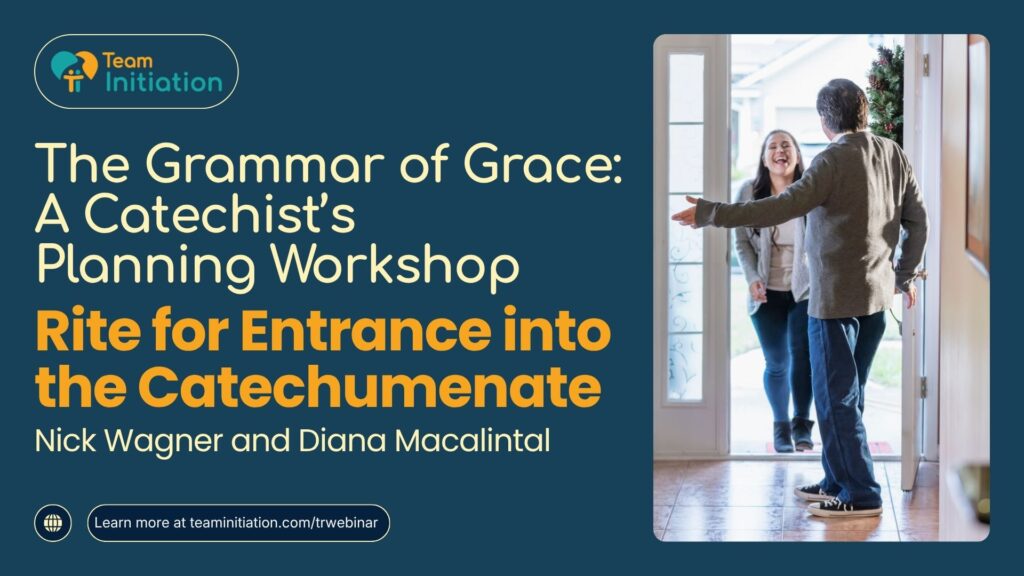
Don’t miss this unique training opportunity to bring your next Rite for Entrance to a new level of spiritual depth and power.