When I was in graduate school, one of my liturgy professors said that the sacrament is not in the book. It is in the community, gathered for worship. What I think he meant by that is that the ritual book is a script or an outline. But it is not the active presence of the Holy Spirit making God’s grace real. That only happens, sacramentally, when disciples gather to pray and worship.
As catechumenate leaders, we can sometimes feel overwhelmed by the “book,” especially the rituals that make up the Order of Christian Initiation of Adults. The rubrics contain a lot of technical details, the choreography is unfamiliar, and the assembly is often not engaged.
Moving beyond words on the page
If that happens to you, remember what my professor told us: the ritual is in the community, not the book. What that means is that your faith and the faith of the community is much more important for the celebration of a rite than your mastery of the rubrics. Yes, you have to have some understanding of the purpose and flow of the rites, but you don’t need an advanced degree in liturgy to celebrate them well. You just need to familiarize yourself with a few basic principles.
The goal of liturgical planning is first of all to facilitate a living encounter with the mystery of Jesus Christ. The rubrics, prayers, and ritual directions are tools to help you do that.
The goal of liturgical planning is first of all to facilitate of living encounter with the mystery of Jesus Christ. The rubrics, prayers, and ritual directions are tools to help you do that.
A blueprint and some tools
So when you are looking ahead to your next catechumenate ritual (say, for example, the Rite for Entrance into the Catechumenate), open to that ritual and start to think of it as a box of tools and a blueprint.
The blueprint will offer you different prayers, different options for choreography, and different musical choices. How do you know what to choose? For every option listed in the ritual, ask yourself which choice will have the best chance of engaging the assembly in the full, conscious, and active participation of the rite? And which option will have the best chance of providing a moment of encounter and transcendence for the seekers.
To make those choices, you have to really think hard about your community. Choices you might make for the 8 am Mass might be different if the rite is celebrated at the 10:30 am Mass. If you are celebrating the rite in Spanish, you might make different choices than if it is to be celebrated in English. If your parish is the cathedral (or looks like a cathedral), you would do things differently than a suburban “modern” church or a small, aging rural church.
A practical checklist
Here is a workflow checklist to help you choose your best options:
- Read the ritual text closely. Identify the purpose, flow, and climax of the rite.
- Find the primary symbols. Choose options that highlight the primary symbols. Downplay or eliminate secondary and optional elements.
- Imagine the music. Even if you are not a musician, you can decide if one part of the rite needs processional music, other parts might need acclamations, and some parts will need silence. Collaborate with your parish musician to choose the best options.
- Physically walk through the rite yourself. Imagine where the catechumens or candidates will be standing. How will they get there? Will they be facing the assembly? If you have a long church, how will the people in the back pews engage with the seekers?
Your seekers are counting on you to provide a space and an experience of transcendence for them.
The impact of a little preparation
I promise if you follow this simple workflow each time a catechumenate ritual is coming up, you will feel a lot more confident (and less stressed) about the rite. And you will dramatically increase the impact it will have on your community and your seekers.
Your seekers are counting on you to provide a space and an experience of transcendence for them. They don’t know you are not a liturgy “expert.” So try a little “fake it till you make it,” and take responsibility for making your catechumenate rituals the best your parish can possibly do. If you try moving the ritual out of the book and into the living hearts of the worshipping assembly, you will be amazed at the transformative power of the catechumenal rites.
Share your experience
What is the biggest challenge your team faces when moving from the “words on the page” to the actual celebration of a rite? Let us know in the comments so we can support one another in this ministry.
Your seekers are counting on you
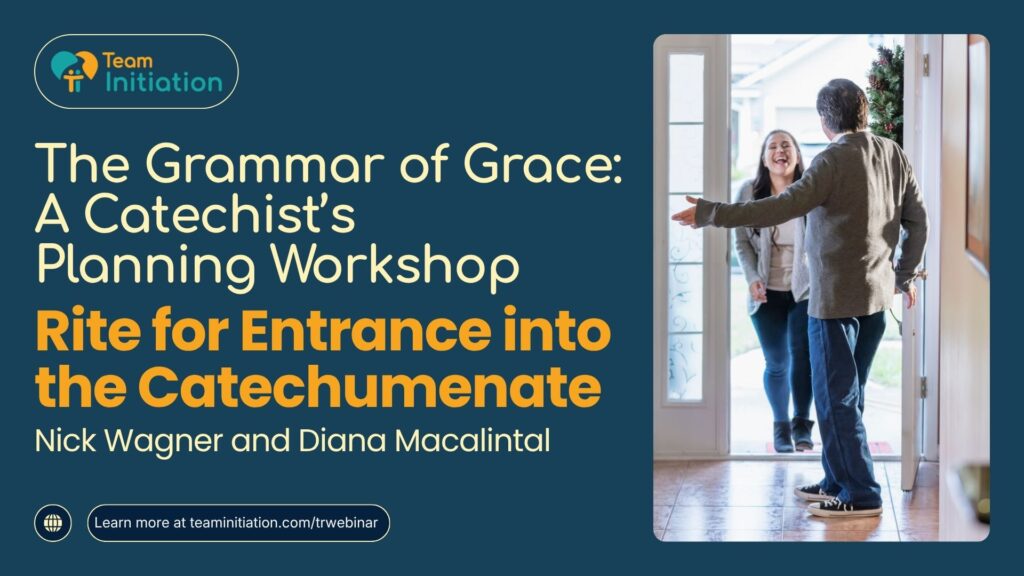
If we treat the catechumenate rites as something someone else handles, they are likely to fail. But when we take responsibility for understanding the essential principles and then design rituals that move the assembly to transcendence, we will transform our seekers and our parishes.
Don’t miss this unique training opportunity to bring your next Rite for Entrance to a new level of spiritual depth and power.