You can reflect questions for every Sunday of the year by clicking here.
The 4th Sunday in Lent
Background: The Pharisees think that they know The Truth about God and about life. To them suffering is a punishment for sin, and God doesn’t listen to the prayers of sinners. Yet in Jesus we come to know a God who step-by-step leads people to know God’s power and compassion and to a clearer vision of the meaning of life. (The man born blind is also an outsider.)
- How have you been blind to a crucial truth about yourself?
- How has Christ’s life already scattered some shadows in your life?
- What are the shadows in society or in the church that obscure for you the light of Christ?
- How can your love bring light and healing to others?
Practice: Light a candle, and stare into its flame as you meditate on your blindness this week. What have you been blinded by? What have you been blind to? Each day list your types of blindness, and write down next to them what you need to say or do to bring light into your darkness.
The 5th Sunday in Lent
Background: Like those preparing for the Easter sacraments, Mary and Martha already have faith in Jesus. Their challenge is to grow in that belief. Can he really do the impossible right here and now—for me? Can he really bring the dead to life—even me? Have we asked him?
- What part of your life makes you feel as if you were living in a tomb? What old habits or perspectives make you feel trapped and lifeless?
- What part of society or the church makes you feel the same way?
- What do you experience a call to come forth from your tomb? To liberation?
- How has Jesus been restoring you to life? When do you feel his new life in you?
Practice: Some people live in tombs—through chronic illness, disability, mental or emotional challenge, age, etc. Look around at your own life, and discover whom you can bring to life simply by reaching out to them. Then do so.
Palm Sunday — Matthew
Background: Christian liturgy is not a play reenacting past events but a living celebration of the inner meaning of those events so that it comes alive in us today. As the oldest Palm Sunday hymn says: “To you before your passion they sang their hymns of praise. To you, now high exalted, our melody we raise.” Matthew’s account of the triumphal entry has two episodes. The point about the donkey is that a victor entered mounted, but with Jesus it is not a warhorse but a humble beast of burden. The crowd’s chant about the “kingdom of David” harkens back to an idyllic reign of justice, harmony, and prosperity
- Why are you happy to join in welcoming Christ today?
- What is Christ asking you to let him make use of as he proclaims today the coming of God’s kingdom/reign?
- What can you do to help others experience the coming of Christ with joy? How will you share the message of Jesus not as judgement but as Good News?
- Jesus is “King of Israel and David’s royal Son.” But anti-Semitism is a persistent Christian sin. Where have you encountered it? What will you resolve to do next time?
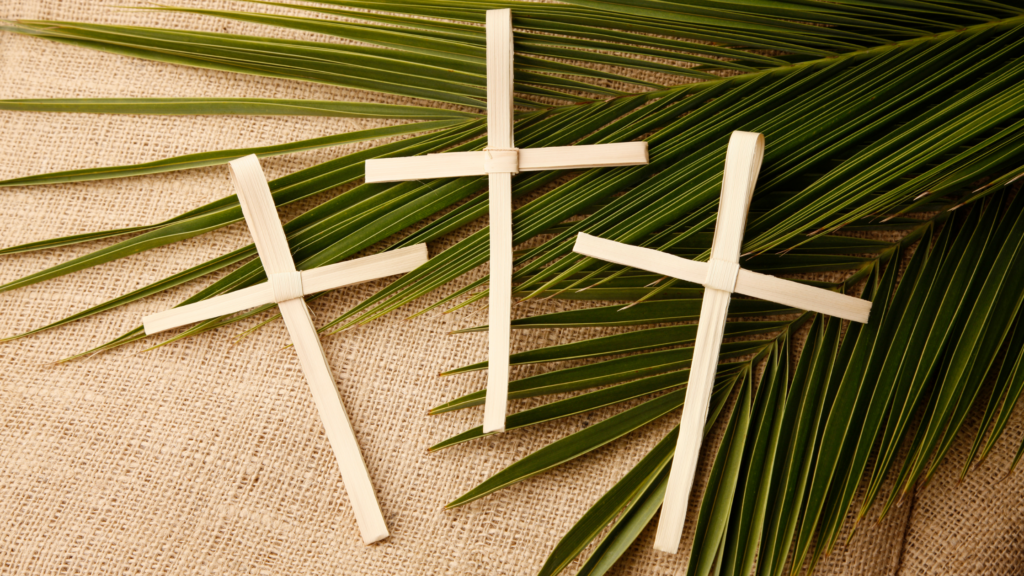
Practice: Placing the palms with the cross or crucifix at home is an old custom—as is weaving them into crosses. Allow this custom to help you keep in mind during prayer this week that both dying and rising are part of the paschal mystery.
Introduction to Triduum and Eastertime
1. If the elect and catechumens are at the liturgies on Holy Thursday and Good Friday, they are supposed to be dismissed after the homily. Yet catechumenate team members do not want to miss participating in those services by going out to lead the dismissal reflection.
From experience it seems that the elect and catechumens are able to “share their joy and their spiritual experience” (OCIA 67a) without a team member as long as they have some guiding questions. Especially if the scrutinies have been a powerful experience for them, the elect are eager to share with each other in these last few days before Vigil.
2. In the post-Vatican II reform of the Roman liturgy, Easter became not a day but a season. The Sundays are not named as “after” Easter but rather “of” Easter. We must not subdivide this season into chunks but celebrate its overall flow.
3. Because the different New Testament writers approached their proclamation of the good news of Jesus from different perspectives, there are two chronologies at work in the readings of this season. For John, on Good Friday Jesus breathes forth his Spirit as he dies, and then blood and water flow from his side. This passage that serves as the guarantee that the rites of initiation at Easter Vigil have power to give rebirth to those who believe. The risen Christ renews that Spirit on the evening of Easter Day when Jesus appears to his disciples in the upper room and breathes the Spirit upon them to empower their mission. In this gospel, Easter Day is the “birthday of the church.” For Luke in the Acts of the Apostles, the definitive sending of the Spirit does not occur until the fiftieth day on Pentecost itself.
This difference in these two chronologies should not disturb us; instead, they give us complementary narratives of the meaning of what God is accomplishing in us and in the world through the death and resurrection of Jesus.
4. During this season in every cycle, the lectionary abandons any use of the Old Testament, the history of God’s dealings with the first community called into existence by divine love. For seven weeks, the first reading is from Acts, portraying life in and the challenges faced by the new Christian community in our earliest days.
In this cycle the second reading is from the First Letter of Peter. Some have wondered if this letter might not be based upon a sermon or series of sermons to the neophytes on the meaning of their Christian initiation. Yet as we hear it now proclaimed Sunday-by Sunday, not only neophytes but long-term Christians are being challenged to ask how the three sacraments of initiation are being lived out in our own lives. As one hymn expresses it: “Christ is risen; we are risen; shed upon us heavenly grace”—the abundant grace of the Holy Spirit.
The gospel selections (almost entirely from John) in every cycle follow the same pattern, one that allows the newly-initiated and the whole community to begin the process of mystagogical reflection upon the sacraments. The first three Sundays describe appearances of the risen Jesus. The next three Sundays focus on our ongoing relationship with the risen Lord, leading up his departure and his parting gift of the fullness of the Spirit.
Because the different New Testament writers approached their proclamation of the good news of Jesus from different perspectives, there are two chronologies at work in the readings of this season…. This difference in these two chronologies should not disturb us; instead, they give us complementary narratives of the meaning of what God is accomplishing in us and in the world through the death and resurrection of Jesus.
Holy Thursday
Background: Mediaeval piety turned Holy Thursday into a second Corpus Christi. The gospels, though, describe the events of Jesus’s final evening as a series of “handings over.” Jesus hands himself over to those who believe in him to be shared in a common meal. Then he goes out to the garden and struggles to hand himself over to the Father in order to carry out the mission for which he was sent. And then he hands himself over to the soldiers in order to begin his passion.
The Roman Rite, though, from its earliest traditions has focused and reenacted another handing over, one found only in John’s Gospel, the foot washing. By washing the feet of his disciples, Jesus shows us the meaning of life in God’s kingdom/reign. He shows us that the path to glory lies through active, humble service. We take up our cross daily, but so often that is an inward acceptance. The foot washing challenges us to a hands-on connection to all of our sisters and brothers in their need.
- As you draw near to the rites of initiation, what are you keeping back? What do you still need to hand over to God through Jesus?
- Whom do you serve on a regular basis? What has that experience meant to you? What have you discovered about yourself?
- Which person in your life has consistently and humbly served you? Have you ever told them of your gratitude?
- Whose feet should the Church wash? How can you help make that happen?
Good Friday
Background: Again, the Roman Rite has always read the Passion account written by John on Good Friday. Each evangelist presents us with a different portrait of Jesus in his final hours. In John Jesus is always the Word made flesh, the Son who is in charge of the situation. And so when he is lifted up on the cross, he takes us with him in his return to the Father. His death is not abandonment or defeat. Because of the ambiguity of certain words in the ancient languages, when Jesus breathes his last, those words can also mean that he is sending forth his Spirit. When his side is pierced, water and blood flow out, signs of the sacraments of initiation that the Church now has power to celebrate to bring new life, love, and victory generation after generation.
- How have you had to surrender in order to grow and move ahead in your life?
- When have you experienced the presence of God in that moment?
- How has Jesus been setting you free over the last weeks and months?
- What do you desire most to have happen during the sacraments of initiation?
Easter Sunday
Background: Today there are two choices for the second reading and three for the gospel. Among these possibilities what stands out is the fact that Jesus’ resurrection two millennia ago is still happening in the lives of baptized Christians.
- What new life and joy is Christ giving you today?
- As living witnesses to Christ’s resurrection, how can we be sure that what we are bringing to people is Good News and not condemnation?
- We are called to celebrate this feast by sharing the “bread of sincerity and truth.” How will you let people see the authentic goodness that God has shaped within you?
- What would bring a springtime of love and care to your family, your neighborhood, and your city?
Practice: Decorate Easter eggs. They are an ancient symbol of new life breaking forth from its old shell. After the egg hunt and without turning it into a grand competition, you can even have an Easter egg fight as Christ struggles once again to get out of the tomb. Yes, Eastern Christians do this all the time.